Cumberland River’s Nashville Growth Before Music City
The Cumberland River’s reliable navigation corridor transformed a frontier settlement into Davidson County’s seat and the state’s capital and commercial center by the mid-1800s. That waterway moved people, supplies, military power, and industrial capacity through Middle Tennessee when no other transport option could match its reach or cost.
From 1779 when Fort Nashborough’s stockade rose on the west bluff through the 1950s before recording studios redefined the city’s identity, the river shaped every stage of Nashville’s growth: fort survival, steamboat trade, Civil War logistics, industrial expansion, and flood-control infrastructure that opened the modern waterfront.
How Did the Cumberland River Enable Nashville’s Founding and Early Survival?
James Robertson’s party arrived at the future Nashville site on Christmas Eve 1779 because the Cumberland offered the only practical route into Middle Tennessee’s interior. The river’s westward flow toward the Ohio provided a two-way highway. Flatboats floated supplies downstream from eastern settlements; keelboat crews poled their way back upstream with trade goods, establishing a two-way exchange.
Fort Nashborough (named for North Carolina General Francis Nash) sat on a limestone bluff 40 feet above normal river level on the west bank. That elevation protected the stockade from seasonal flooding while keeping boats within musket range of the landing below. The 200 settlers who arrived in spring 1780 depended entirely on river transport for gunpowder, salt, and iron tools through the early 1780s. Overland wagon routes wouldn’t reach Nashville until the Natchez Trace opened in 1801.
The river also fed the settlement. Cumberland catfish, paddlefish, and mussels supplemented corn and wild game during the garrison years. By 1784 when the fort disbanded and log cabin homesteads spread across the bottomlands, river access had attracted enough families to support a ferry crossing and the first commercial mill on Mill Creek tributary.
Best nashville river cruises for groups today depart from East Bank Dock at 2 Victory Ave, roughly a half-mile downstream from where those original flatboats tied off in 1780. The same bedrock channel that drew Robertson’s party still shapes how we experience the waterfront.
What Role Did the Cumberland Play During Nashville’s Steamboat and Civil War Era?
Steamboat service transformed Nashville from regional crossroads into Tennessee’s second-largest city by 1850. The first steamboat General Jackson reached the public wharf in 1819, cutting Louisville-to-Nashville travel time to four days. Packet boats that had taken two weeks by keelboat now ran scheduled service. Within a decade, 30 packet boats connected Nashville and New Orleans, moving cotton bales south and manufactured goods north.
The river’s navigability 200 miles upstream from its confluence with the Ohio made Nashville a break-in-bulk hub. Cargo transferred from river packets to freight wagons serving the southeastern interior. By 1860 the Nashville wharf district stretched a mile along the riverfront with 12 commission houses and 4 cotton presses serving regional trade.
That strategic transport position made Nashville a military prize during the Civil War. Union forces captured the city in February 1862 specifically to control Cumberland River logistics. Federal gunboats and supply steamers moved 15,000 troops and their equipment upriver from Paducah in a week. That concentration of force would have been impossible over muddy winter roads. Nashville remained a Union garrison and supply depot through 1865, with the river delivering rations, ammunition, and reinforcements that sustained Sherman’s Atlanta campaign and Thomas’s Army of the Cumberland.
Confederate forces never retook the city partly because they couldn’t interdict river traffic. Federal gunboats patrolled the Cumberland from its mouth to Carthage, 60 miles upstream from Nashville, keeping the supply line open even when Confederate cavalry raided the rail lines.
How Did Industrialization and Flood Control Change the River’s Role?
Post-war industrial expansion in the 1870s–1900s anchored Nashville’s economy to river commerce even as railroads grew. The Louisville & Nashville Railroad reached Nashville in 1859, but bulk goods (coal and pig iron) still moved cheaper by water. By 1890 Nashville’s riverside industrial corridor included a shoe factory, a bedspring works, two flour mills, a cottonseed oil plant, and the Tennessee Manufacturing Company’s textile mill.
The river powered those factories. Low-head dams at Bells Bend and Pennington Bend generated hydroelectric current for industrial machinery before citywide electrical service existed. Factories drew process water directly from the Cumberland, and dumped waste back into it (a practice that continued until the Clean Water Act in 1972).
The river also punished the city. Catastrophic floods in 1926 and 1937 inundated downtown Nashville under 10–15 feet of water, destroying millions in property and killing dozens. The 1937 flood crested at 52.3 feet (12 feet above flood stage) and submerged Broadway from the riverfront to 5th Avenue.
Those disasters prompted the U.S. Army Corps of Engineers to build the system of locks, dams, and reservoirs that now regulates Cumberland flow. Old Hickory Dam (completed 1954) and J. Percy Priest Dam (1968) upstream from Nashville ended seasonal flooding and maintained a year-round navigation channel 9 feet deep. The regulated river enabled modern development along the East Bank, including the sports stadium district, Nissan Stadium, and the marinas where corporate cruises and private event charters now operate.
Flood-control dams stabilized the river but interstate highways made barge shipping uncompetitive. By the 1970s, industrial warehouses along the waterfront had been replaced by entertainment venues and river boat cruises.
FAQ: Cumberland River’s Historical Role in Nashville
Why was the Cumberland River critical to founding Fort Nashborough in 1779? The river provided the only reliable transport route into Middle Tennessee’s interior. Flatboats could deliver supplies from eastern settlements, and the waterway connected the fort to trade networks reaching the Ohio and Mississippi rivers.
How did steamboats change Nashville’s economy in the 1800s? Steamboat service starting in 1819 cut travel time to four days, enabling scheduled packet service to New Orleans. By 1850 Nashville had become a break-in-bulk hub where river cargo transferred to wagons for southeastern distribution, fueling growth into Tennessee’s second-largest city.
What made the Cumberland River strategically important during the Civil War? The river allowed Union forces to move 15,000 troops and equipment from Paducah to Nashville in one week in February 1862. Federal control of the waterway kept supply lines open to Nashville’s garrison even when Confederate cavalry disrupted rail service.
How did flooding shape the river’s 20th-century role? The catastrophic 1926 and 1937 floods (the latter cresting at 52.3 feet and submerging downtown under 12 feet of water) prompted construction of upstream dams. Old Hickory Dam (1954) and J. Percy Priest Dam (1968) ended seasonal flooding and enabled modern East Bank development.
When did the Cumberland transition from industrial use to recreational cruising? Flood-control dams in the 1950s–60s stabilized river levels but interstate highway expansion reduced the cost advantage of barge shipping. Industries relocated away from the waterfront in the 1960s–70s, opening the river corridor to tourism and entertainment uses by the 1980s.
Experiencing Nashville’s River Heritage Today
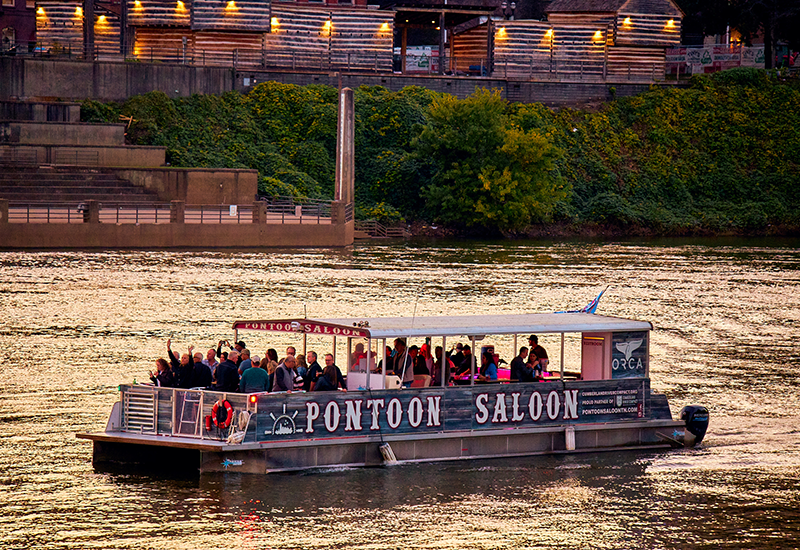
Entertainment has replaced commerce on the Cumberland, but tourists and locals now experience the same river that built Nashville. The bedrock channel that floated Fort Nashborough’s supply flatboats and Civil War gunboats now carries modern pontoon vessels past the skyline.
Pontoon Saloon operates from East Bank Dock where the old packet-boat wharves once stood. Our 2-hour cruises pass landmarks that mark the river’s industrial past: the Jefferson Street Bridge (built 1909 to connect riverside factories), the site of the old wharf district (now Riverfront Park), and the bedrock bluffs that protected Fort Nashborough’s original stockade.
Every cruise includes a USCG Licensed Captain and Deckhand who know the river’s history as well as its navigation. Our cruises follow the same water that carried Robertson’s flatboats, Union gunboats, and steamboat captains across two centuries of Nashville’s transformation.
Corporate events, private celebrations, and first-time visitors all discover Nashville’s story best from the water—the same vantage point that revealed the city’s promise to James Robertson in 1780. The river gave Nashville its start as a frontier fort, sustained it through war and industrial growth, and now offers the best seat for watching a modern skyline that wouldn’t exist without those original currents.
Book your cruise from Lock One Marina today. Call 615-601-1464 or reserve online for seven-day-a-week departures. Outside beverages aren’t permitted, but our onboard bar and 3/4-covered roof keep groups comfortable while the Cumberland tells its story. For groups of 10 or more, we recommend booking 90 days out to secure your preferred date on the water that built Music City. Best nashville river cruises for groups run every day of the week.